CARS.COM CONNECTED · SELF-INITIATED STRATEGIC PROTOTYPE

I turned a broad dashboard brief intoa connected decision system.

I built a self-initiated, role-aware working prototype connecting dealer and Cars.com decisions through shared evidence, reusable workflows, and human-supervised actions.

DIRECT PROTOTYPE STATES · ROLE-AWARE DEALER VIEWS

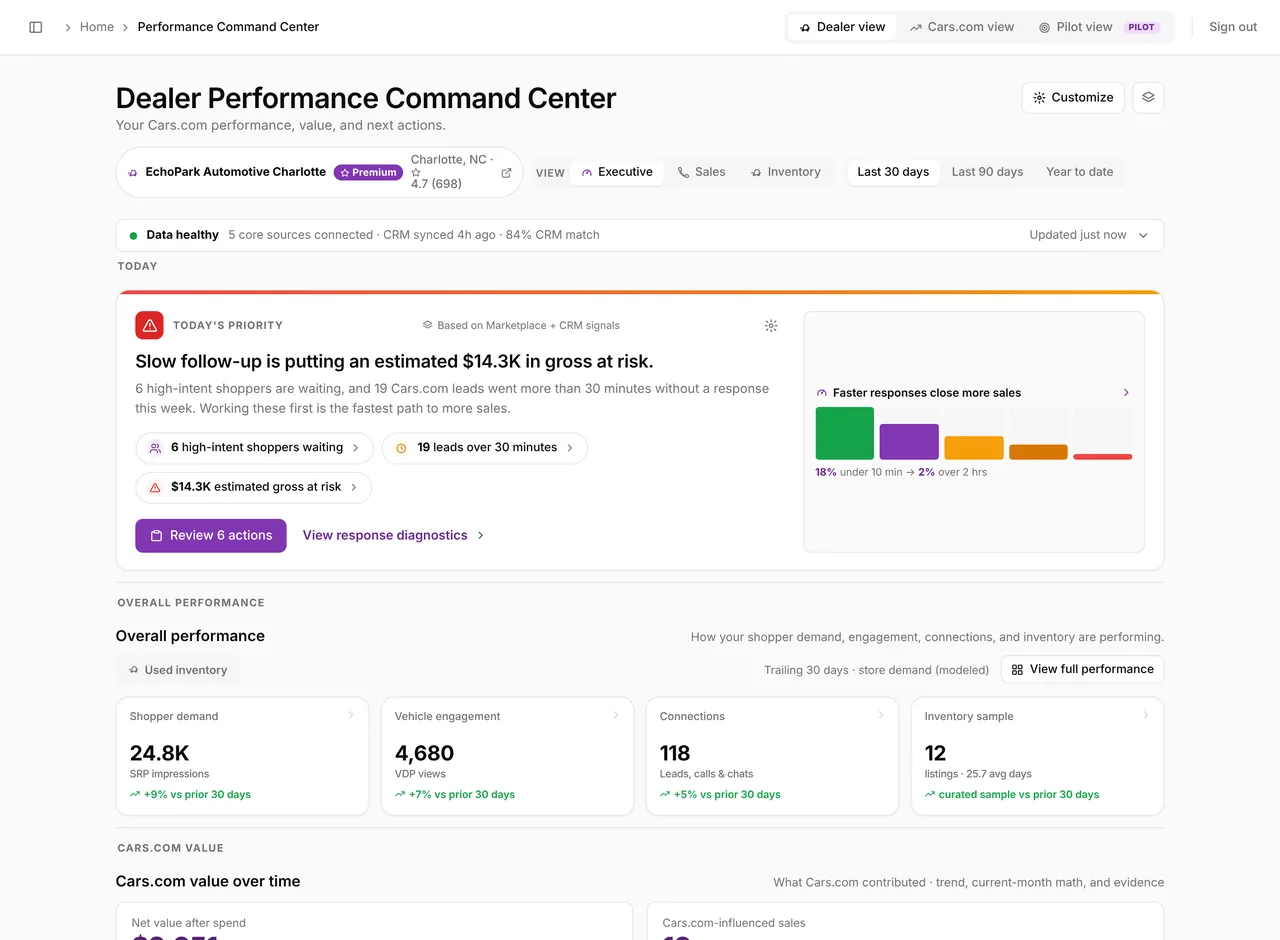
EXECUTIVE VIEW

Dealer executive view showing performance, risk, evidence, and next action

Priority · performance · value · action · proof
SALES / BDC VIEW

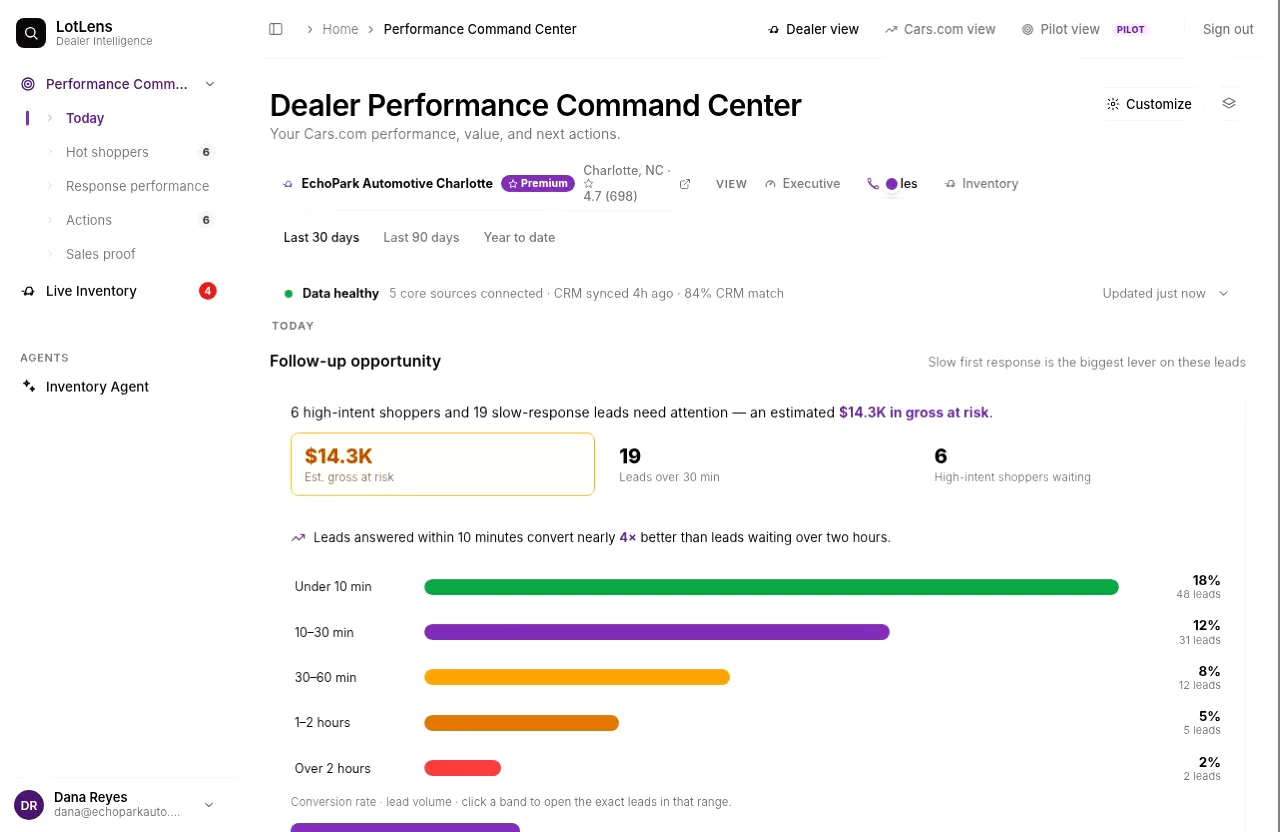
Sales and BDC view showing lead follow-up and appointment priorities

Follow-up · hot shoppers · response · actions · proof
INVENTORY VIEW

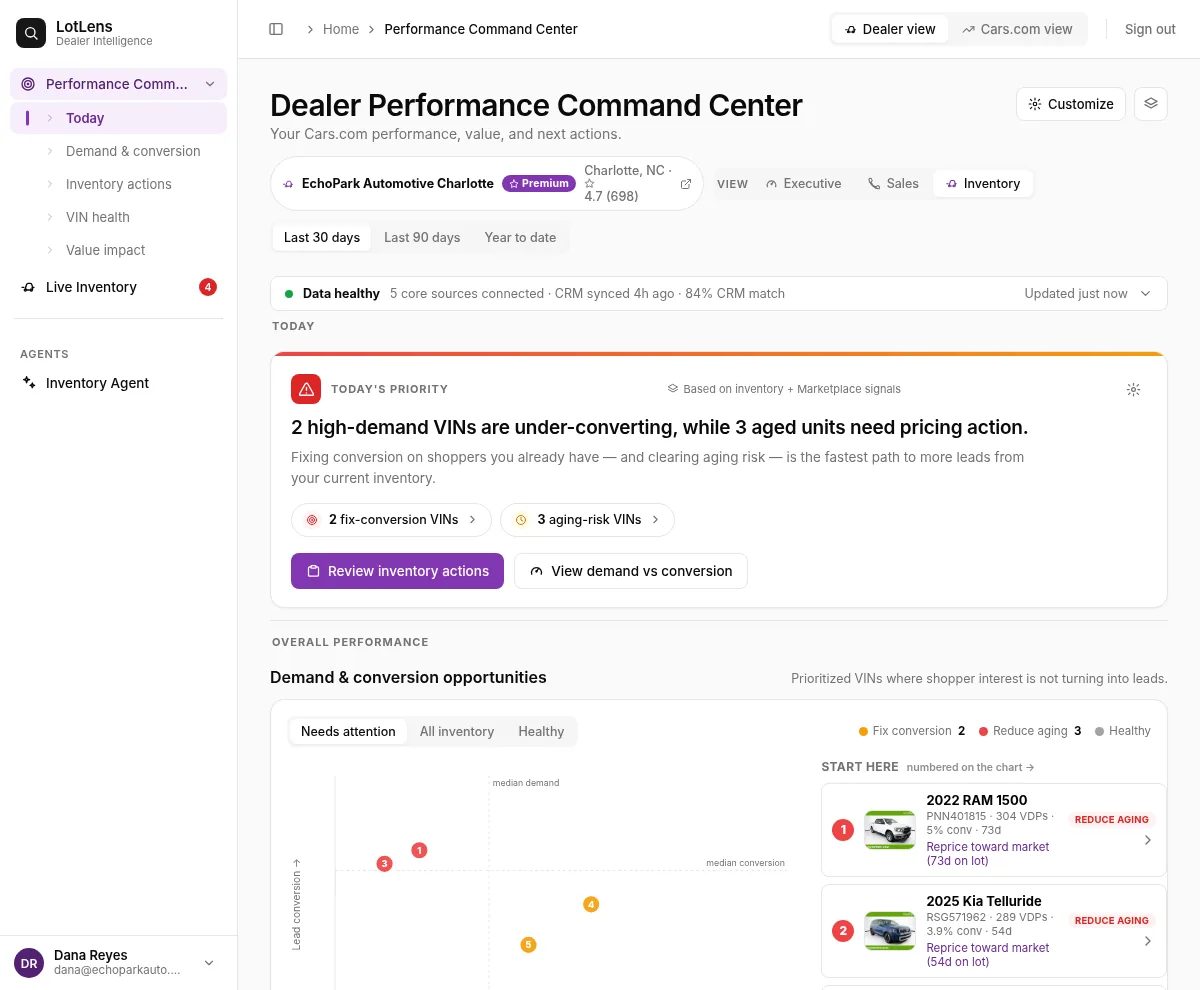
Inventory view showing listing quality, demand, and pricing priorities

Priority · demand vs conversion · VIN actions · value impact

SYSTEM

2 sidesDEALER + CARS.COM
4 jobsEXECUTIVE · SALES · INVENTORY · CSM
6 layersDEMAND → BUSINESS VALUE
1 prototypeROLE-AWARE + INTERACTIVE

THE BRIEF NAMED WORKSTREAMS · NOT A PRODUCT

The assignment was broad by design.My first job was to find the product spine.

The kickoff covered strategy, audiences, data, technology, and agentic operations. I translated that material into a more basic product question: who needs to decide what, and what evidence would help them do it?

REPORTING-FIRST

What happened?

  • Traffic
  • VDP views
  • Leads
  • Source mix
  • Product attach visibility

Useful, but passive. The page describes activity without helping anyone decide what to do next.

DECISIONING-FIRST

What should we do next?

Prove value
Incremental units + gross
Prioritize action
Hot shoppers + VIN fixes
Improve execution
Lead response + funnel leakage
Drive expansion
Product contribution + attach

Product spine: dealer value first. Every other module explains or improves it.

ONE SENTENCE EVERYONE COULD REPEAT

Help a dealer see where Cars.com created value, where the store is leaking gross, and what to act on next.

Primary KPI: incremental gross-to-spend ROI · Business outcome: retention + ARPD + product attach
DO NOWClosed-loop ROI · hot shoppers · VIN health · lead response · product contribution
NOT V1CRM replacement · DMS workflow · OEM reporting · consumer dashboard

DEALER DECISION LAYER · SAME SYSTEM, DIFFERENT ORDER

Each role sees what matters first.The evidence underneath stays connected.

The executive, sales, and inventory views use the same marketplace, CRM, inventory, and value data. Each view changes the order to match the work that role owns.

EXECUTIVE

Where is value leaking, and what should happen first?

Dealer executive view showing performance, risk, evidence, and next action

Priority · performance · value · action · proof

Priority
Lead with the consequential issue
Evidence
Keep the underlying signal inspectable
Action
Let the next step happen in context

SALES / BDC

Who needs follow-up, and why does speed matter?

Sales and BDC view showing lead follow-up and appointment priorities

Follow-up · hot shoppers · response · actions · proof

Priority
Lead with the consequential issue
Evidence
Keep the underlying signal inspectable
Action
Let the next step happen in context

INVENTORY

Which VINs need conversion or pricing action?

Inventory view showing listing quality, demand, and pricing priorities

Priority · demand vs conversion · VIN actions · value impact

Priority
Lead with the consequential issue
Evidence
Keep the underlying signal inspectable
Action
Let the next step happen in context

ROLE-AWARE MODULE ORDER

EXECUTIVEPriority → performance → value → action → proofSALES / BDCFollow-up → shoppers → response → actions → proofINVENTORYPriority → demand / conversion → VIN actions → value impact

CONNECTED INTERNAL WORKFLOW · FROM ACCOUNT SIGNAL TO COMMERCIAL ACTION

The Cars.com side asks a different question:what moves my number?

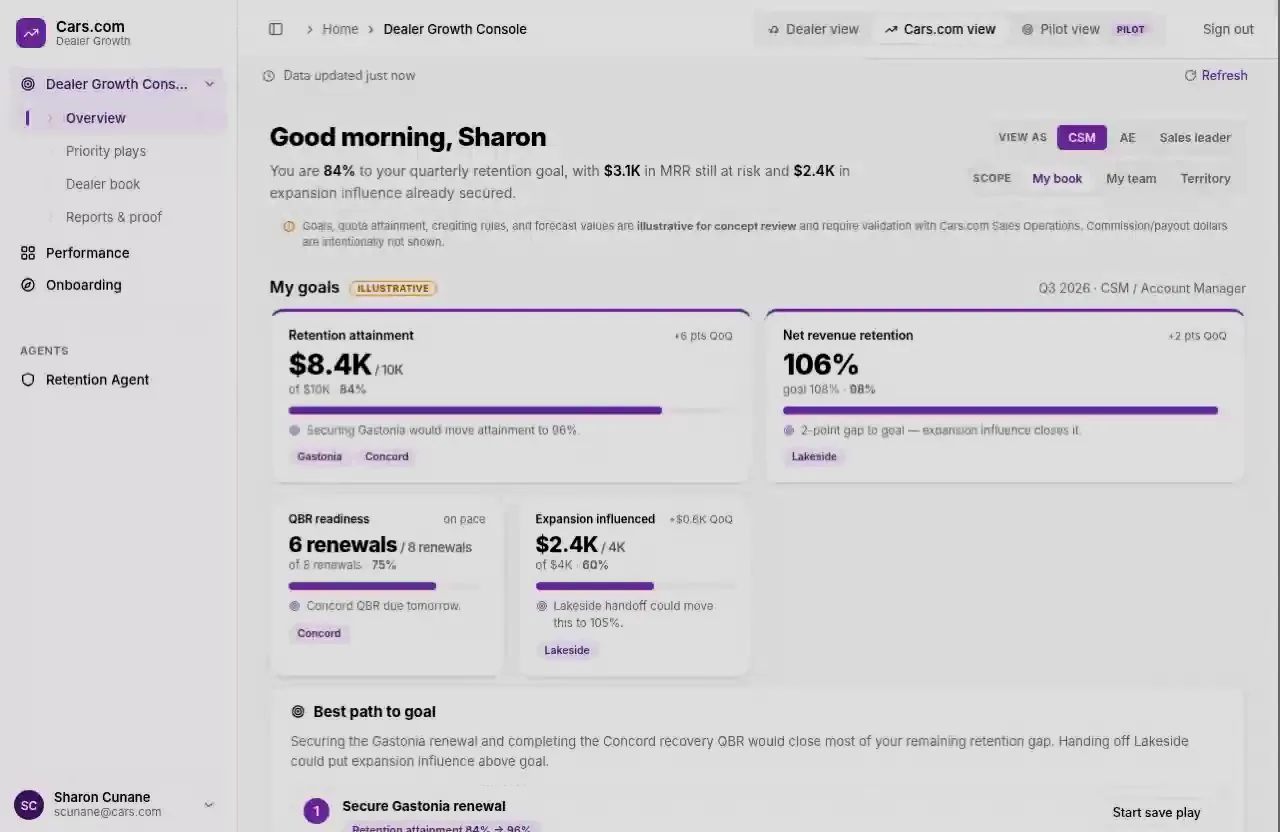
CSM, AE, and sales-leader modes reorder the same account evidence around retention attainment, NRR, QBR readiness, expansion influence, risk, credit state, and the best path to goal. The system translates the same reality into the work Cars.com teams own.

01

GOAL

What am I accountable for?

02

PLAY

Which account move matters most?

03

EVIDENCE

What makes the recommendation credible?

04

ACTION

Who owns the next step?

05

OUTCOME

What counts as progress or credit?

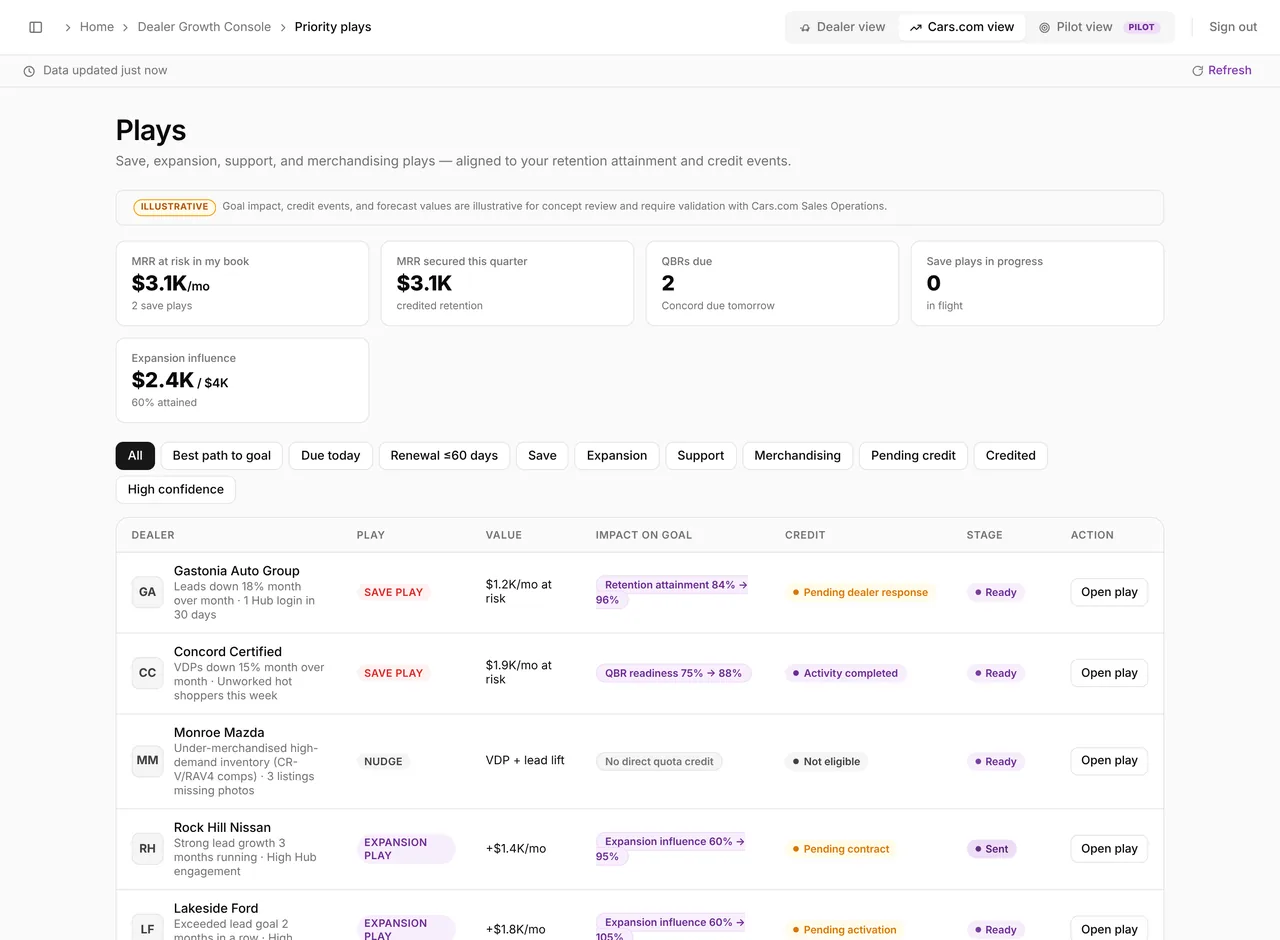
Ranked Cars.com account priority plays
PRIORITY PLAYSSignals become a ranked commercial move with ownership.
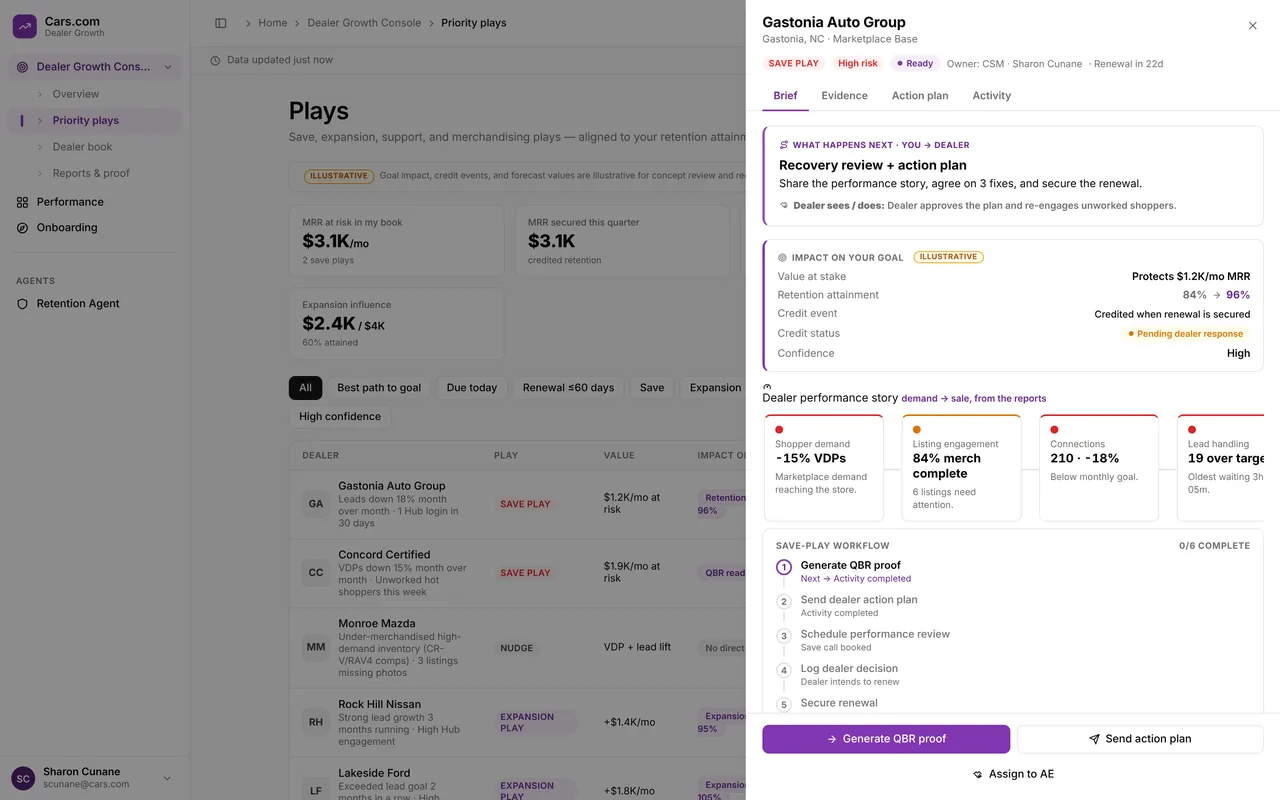
Cars.com account brief with connected evidence
ACCOUNT BRIEFEvidence stays connected to the dealer conversation.
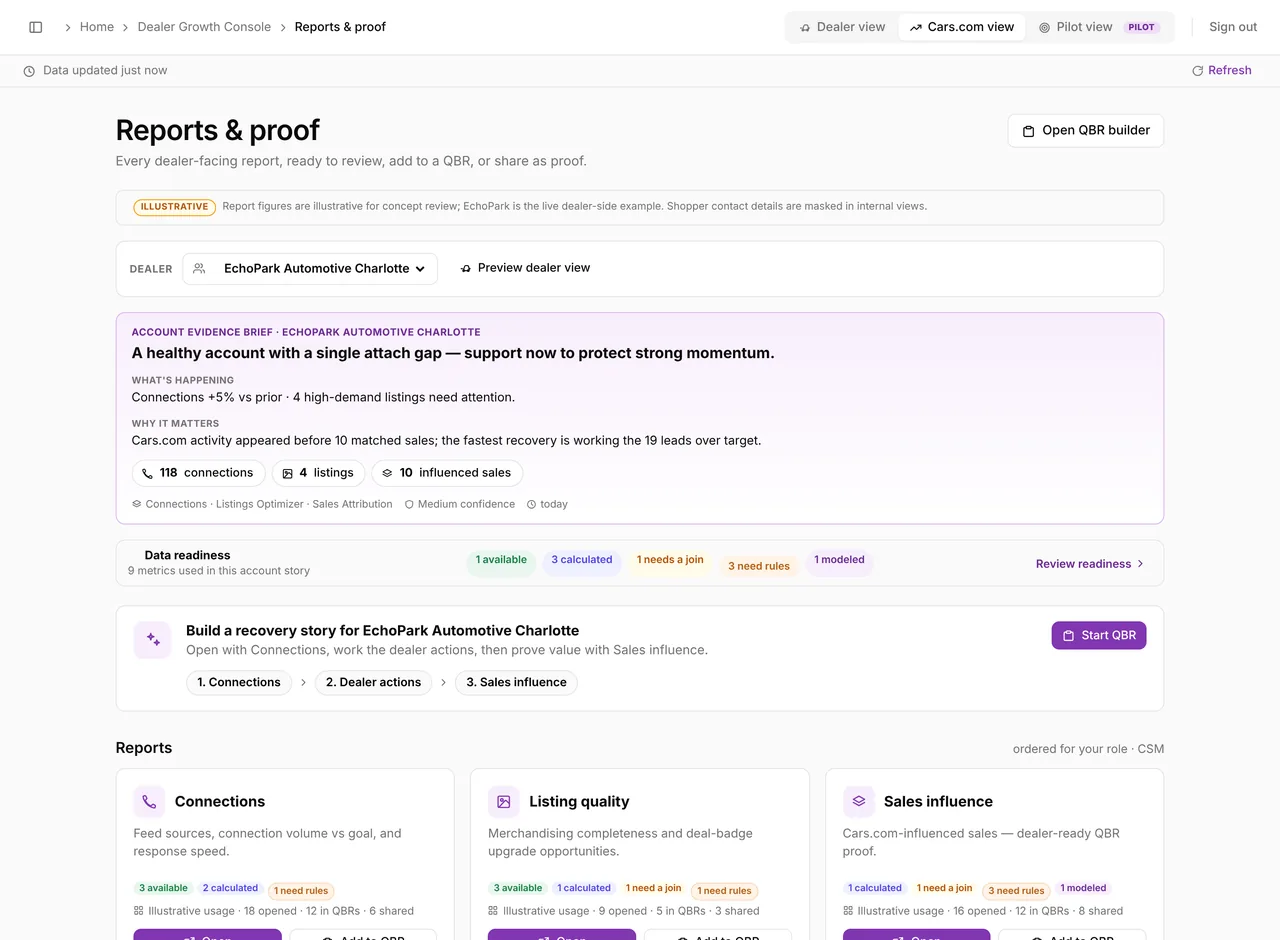
Cars.com reports and proof composition
REPORTS + PROOFClaims remain inspectable before a recommendation is accepted.
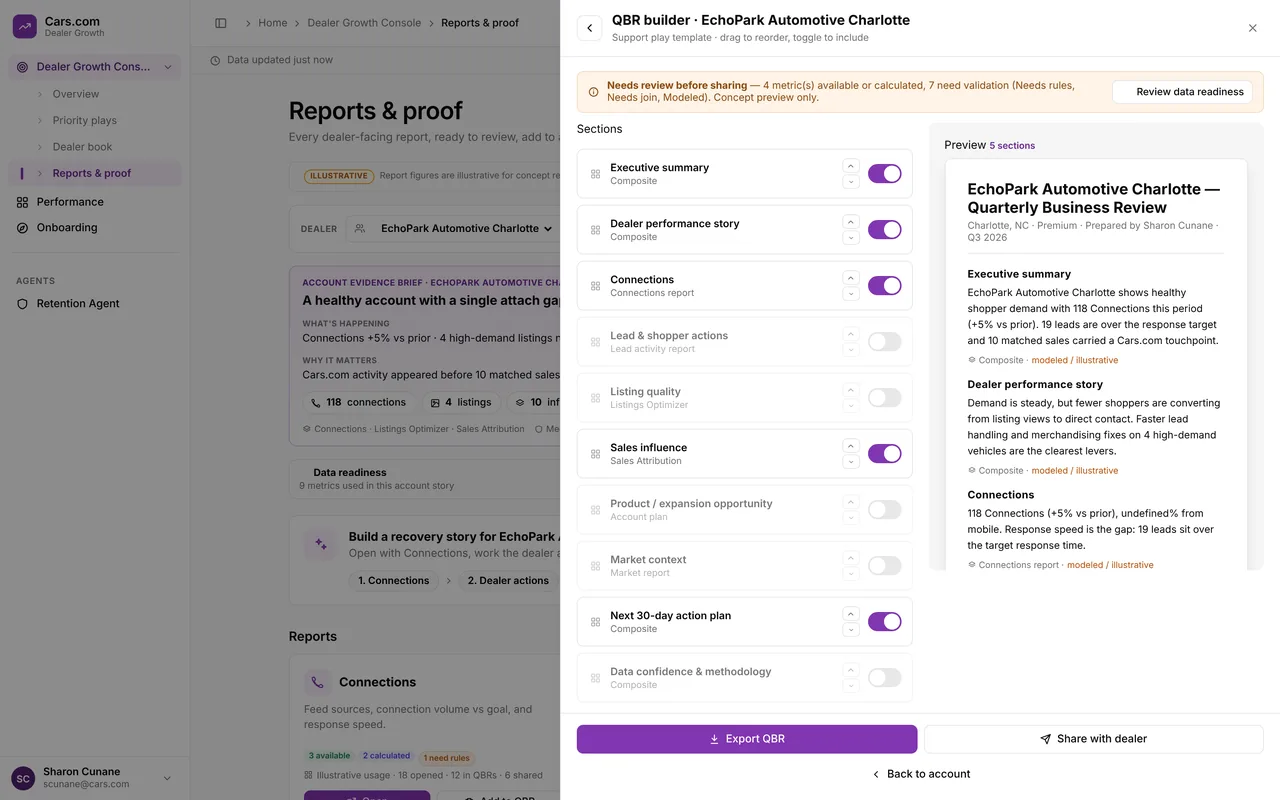
Cars.com QBR composition workflow
QBR COMPOSITIONThe same evidence becomes a reviewable account story.

DIRECT INTERACTION CAPTURES · THE PRODUCT LOGIC IN MOTION

Motion makes the product logic legible.Three loops prove more than a wall of small screenshots.

These captures come directly from the working HTML prototype. They show role-aware ordering, progressive disclosure from priority to action, and a human-supervised recommendation loop.

ROLE-AWARE SYSTEMExecutive, Sales / BDC, and Inventory modes reorder one governed evidence model around the decision each role owns.
DECISIONINGA business implication opens the exact shoppers and records behind it, then lets the user act without losing context.
HUMAN-SUPERVISED AIThe agent surfaces evidence and a recommended play. A person accepts, assigns, dismisses, or overrides it.

DENSE STATES · SOURCE CAPTURES

Connected dealer and Cars.com prototype overview
COMPLETE WORKING SYSTEM
Priority plays dense product state
PRIORITY PLAYS
Account brief dense product state
ACCOUNT BRIEF
Reports and proof dense product state
REPORTS + PROOF
QBR composition dense product state
QBR COMPOSITION
Open the connected dealer + Cars.com prototype  ↗

AI helped me branch and build faster. Clicking through the product is what exposed missing logic, weak labels, dead ends, and unsupported claims.

PRODUCT JUDGMENT · CLEAR BOUNDARIES

A confident prototype still needs honest limits.What it knows. Where it is unsure.

Seeded data, modeled attribution, and AI recommendations can still support useful product decisions when the interface makes their status explicit. The point is not to make the prototype sound certain. It is to make uncertainty actionable and reviewable.

GUARDRAILS BUILT IN

  1. Illustrative and modeled values are labeled in context
  2. Influenced sales stay separate from incremental estimates
  3. Readiness states expose joins, rules, definitions, and confidence
  4. Agents recommend; people accept, dismiss, assign, and own outcomes
  5. No false urgency, hidden causality, or invented production results
  6. Not a CRM, DMS workflow, OEM report, or consumer dashboard

WHAT I WOULD VALIDATE NEXT

Action adoption
Do role-specific priorities shorten time to the right action?
Attribution trust
Can users explain influenced vs incremental value without help?
QBR effort
Does connected evidence reduce manual account-story work?
Role fit
Does each ordering match the real decision cadence?
Module reuse
Can the system support more accounts without one-off pages?

The standard is not “did AI make a dashboard?” It is “did the process produce a clearer product, a safer evidence model, and a better question to test next?”

WHAT THE PROTOTYPE PROVED

One evidence model could supportdifferent roles without hiding uncertainty.

The prototype connected dealer value, internal commercial action, and human-supervised recommendations in one role-aware model. It clarified what should be tested next while keeping seeded data, modeled attribution, and human ownership explicit.

2 sidesDEALER + CARS.COM
4 jobsEXECUTIVE · SALES · INVENTORY · CSM
6 layersDEMAND → BUSINESS VALUE
Human supervisedAGENTS PROPOSE · PEOPLE OWN